
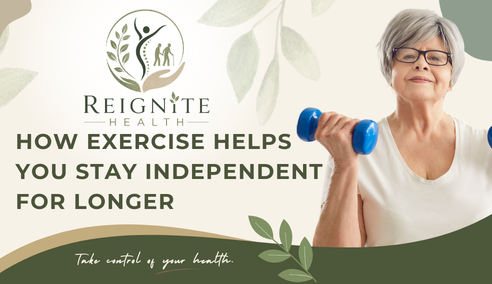
Being independent is more than being able to live alone. It means being able to get out of a chair, walk to the shops, climb stairs, carry your groceries, get dressed, prepare a meal and participate in the activities you enjoy.
As we age, or when we live with an injury or chronic condition, some of these abilities can gradually become more difficult. However, physical decline is not always something we simply have to accept. Regular, appropriately prescribed exercise can help maintain the physical abilities needed for everyday life.
At Reignite Health in Fourways, Bokamoso Mthimkulu Biokineticist uses exercise and movement rehabilitation to help individuals maintain strength, mobility, balance and physical independence.
What Does Physical Independence Mean?
Physical independence means having the physical ability to manage your everyday activities with as little assistance as possible.
This could include:
- Getting in and out of bed
- Standing up from a chair
- Walking independently
- Climbing stairs
- Getting dressed
- Bathing
- Preparing meals
- Carrying shopping bags
- Getting in and out of a car
- Moving around your home safely
- Participating in hobbies and social activities
The level of independence someone needs will differ from person to person. The goal isn’t necessarily to do everything alone. The goal is to maintain as much safe, meaningful function as possible.
Why Does Independence Become More Difficult with Age?
Ageing is associated with changes in muscle mass, strength, balance, mobility and cardiovascular fitness.
However, ageing itself isn’t the only factor. Physical inactivity can accelerate the loss of physical capacity.
For example:
Less activity → reduced strength and fitness → everyday activities become harder → activity decreases further.
This can become a cycle of deconditioning. Exercise can help interrupt that cycle by giving your body regular opportunities to maintain and develop its physical capacity.
6 Ways Exercise Can Help You Stay Independent
1. Exercise Helps Maintain Muscle Strength
Muscle strength is essential for everyday activities. Think about what your legs need to do just to stand up from a chair; they need enough strength to move your body against gravity.
The same applies when you:
- Climb stairs
- Getting out of bed
- Walk uphill
- Get into a vehicle
- Carry shopping
- Stand for longer periods
Strength training can help maintain or improve the muscle strength needed for these activities and you don’t necessarily need heavy weights. Exercises can be adapted according to your age, fitness level, health conditions and current strength.
2. Exercise Helps You Maintain Balance
Good balance becomes particularly important as we get older. Balance allows you to remain stable while:
- Standing
- Walking
- Turning
- Stepping over obstacles
- Getting in and out of a chair
- Moving around your home
Balance can be challenged and trained through appropriately prescribed exercises. Maintaining balance can also help you feel more confident when moving.
3. Exercise Keeps You Moving
Mobility is your ability to move your body through the ranges of motion needed for everyday life. Reduced mobility can make simple tasks more difficult. For example, limited hip or ankle mobility may affect walking, while reduced shoulder mobility may make reaching overhead more difficult. A Biokineticist can incorporate mobility exercises into a broader programme that also addresses strength and function.
4. Exercise Supports Cardiovascular Fitness
Being independent requires more than muscle strength. You also need enough cardiovascular capacity to perform activities without becoming excessively tired.
Walking around a shopping centre, climbing stairs or doing household tasks can become challenging when cardiovascular fitness declines. Regular aerobic exercise can help maintain cardiovascular fitness and make every day physical activity more manageable.
5. Exercise Can Help Reduce the Effects of Inactivity
Illness, injury, surgery and chronic conditions can sometimes cause people to become less active. The longer physical activity is reduced, the more physical capacity can be lost.
A carefully structured exercise programme can help someone gradually rebuild their strength, fitness, mobility, balance, exercise tolerance, and confidence with movement.
The programme doesn’t need to start at the level you were previously capable of. It starts at the level you are capable of now.
6. Exercise Helps You Keep Doing the Things You Enjoy
Independence isn’t only about basic activities. It’s also about being able to participate in your life hobbies.
That might mean:
- Playing with your grandchildren
- Gardening
- Travelling
- Going out with friends
- Walking your dog
- Shopping independently
- Playing recreational sports
- Attending social events
Maintaining your physical capacity can help you continue participating in activities that contribute to your quality of life.
Strength Training Is Particularly Important
Many people associate exercise with walking or cardiovascular fitness. While aerobic activity is important, strength training deserves particular attention as we age. Muscle strength contributes to many everyday movements. A strength programme might include exercises such as:
- Sit-to-stands
- Step-ups
- Squats
- Resistance-band exercises
- Weight training
- Functional lifting exercises
What About People with Chronic Conditions?
Living with a chronic condition does not automatically mean that you cannot exercise. In fact, appropriately prescribed exercise can form part of the management of many chronic conditions.
For example, people living with:
- Arthritis
- Diabetes
- Hypertension
- Multiple sclerosis
- Parkinson’s disease
- Stroke-related disability
- Lupus
- Heart disease
- Other neurological conditions
may benefit from individualised exercise programmes.
However, exercise needs to take the individual’s condition, symptoms, medication, physical abilities and medical recommendations into account. This is where exercise rehabilitation can be particularly useful.
Why Starting Earlier Matters
Think of exercise as an investment in your future independence. You are not only exercising for what your body can do today. You’re also working towards maintaining the ability to do things years from now.
The earlier you identify declining strength, balance or mobility, the more opportunity there may be to address those areas through appropriate exercise.
How Can a Biokineticist Help?
A Biokineticist looks at how your body moves and functions and uses prescribed exercise as part of rehabilitation and health management.
An assessment may consider:
- Muscle strength
- Cardiovascular fitness
- Balance
- Mobility
- Functional movement
- Exercise tolerance
- Current activity levels
- Relevant health conditions
- Individual goals
From there, an exercise programme can be developed around your needs and abilities. As your physical capacity improves, the programme can be progressed.
Independence Is Something Worth Working Towards
We often think about independence only when we begin to lose it. But physical independence can be something we actively work to maintain.
Regular exercise can help support the strength, balance, mobility and cardiovascular fitness needed to perform everyday activities. It isn’t about trying to stop ageing, it’s about helping your body remain capable for as long as possible.
At Reignite Health in Fourways, Bokamoso Mthimkulu Biokineticist provides individualised exercise rehabilitation for people who want to improve their physical function, manage chronic conditions and maintain their independence.
If you’re noticing changes in your strength, balance, mobility or ability to perform everyday activities, a Biokinetics assessment can help identify where to start.
Stay strong. Keep moving. Maintain your independence.
Wishing you a lovely week ahead. Chat soon.
Bokz the Bio
Everybody has the ability to take control of their own health
Facebook: Reignite Health
LinkedIn: Reignite Health
Website: reignitehealth.co.za
WhatsApp: +27 83 562 9201
Email: bmbio@reignitehealth.co.za