
Hello! Welcome to Reignite Health, Bokz the Bio here ready and happy to educate you more on health so you can reignite your health.
Today’s topic will be looking more into the different ways you can activate your skeletal muscles.
So, what is a muscle?
A muscle is an organ in the body that contracts when stimulated by a nerve. This allows the body to perform a desired movement.
The body consists of smooth muscle, cardiac muscle, and skeletal muscle. Smooth muscle, such as the stomach, oesophagus, and intestines, contract and relax involuntarily. Cardiac muscle is specific to the heart. It also contracts and relaxes involuntarily. Lastly, skeletal muscle are muscles that attach to your bones such as the muscle in your arms and legs. They contract and relax voluntarily which means that you control how and when they perform a movement. Biokineticists mainly work on skeletal muscle functionality.
Types of skeletal muscle contractions?
There are three main ways you can activate your muscles. This is through isometric, isotonic and isokinetic contractions.
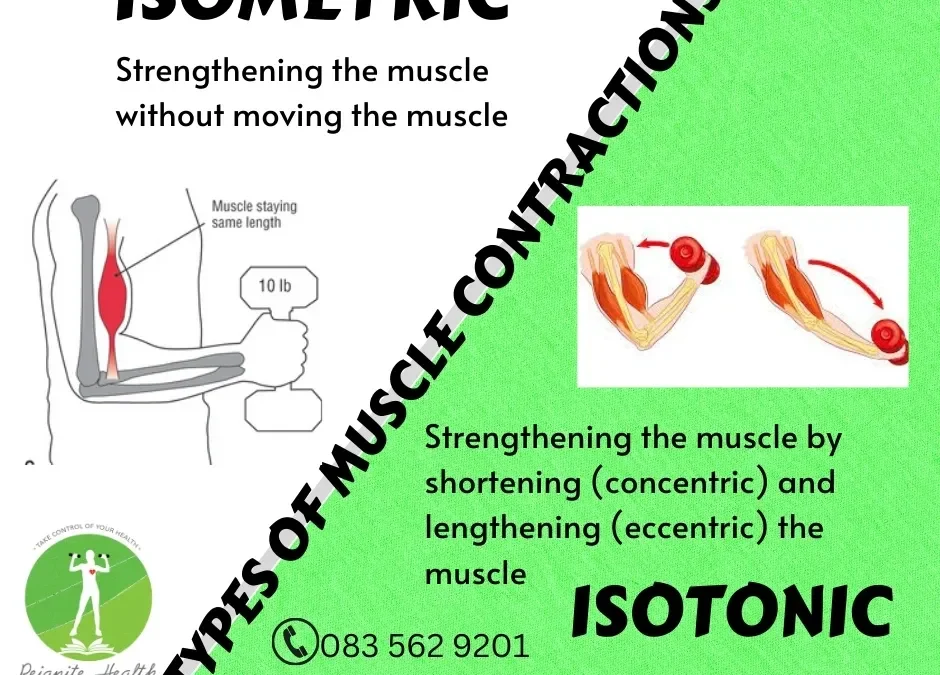
Isometric contractions take place when your muscle produces tension with no change in its length. This means that the muscle does not shorten or lengthen during a movement, but it is still activated to perform a certain task. Examples of isometric contractions include a plank, wall sit, and hip lift hold.
Isotonic contractions take place when your muscle shortens and lengthens throughout its entire range of motion. Shortening of the muscle is known as a concentric contraction. Lengthening of the muscle is known as an eccentric contraction. Almost every muscle has and equal and opposite muscle, meaning when one muscle shortens the opposite muscle lengthens. And thus, concentric and eccentric contractions happen simultaneously. Examples of isotonic contractions include push ups, squats, calf raises, tricep dips, and bicep curls.
Lastly, isokinetic contractions take place when a muscle group moves through a specific range of motion at a fixed speed with varying resistance. Examples of isokinetic contractions include indoor bicycle, arm ergometer, and a treadmill. In rehabilitative spaces, an isokinetic machine can be used to strengthen muscles against a constant resistance, and test for discrepancies in muscle strength between left and right side as well as antagonistic muscles. Knee extension, hamstring curl, shoulder external and internal rotation are examples of exercises than can be done on this machine.
There are certain situations where a muscle contraction is involuntary. These are important to maintain posture (muscle tone) and to avoid dangerous situations (reflexes), respectively. The former is a tonic contraction and the latter a reflexive contraction.
How a Biokineticist help you improve your muscle activation?
Optimal activation of skeletal muscle, specifically when suffering from long term pain, an injury, or a physiological deficit can be distorted. Even if you are a healthy person, sometimes you may not be effectively using certain muscles without realising it, for example postural muscles when sitting or standing for a long time.
Biokineticists educate and support you in improving activation of all muscles allowing for stronger brain-body connections and muscle utilisation. They also show you how movement can facilitate healing and improve functionality. Contact me to book your first appointment with us.
Looking For A Biokinticist In Fourways?
Book an assessment with Bokamoso Mthimkulu Biokineticist at Reignite Health and discover how exercise can help reduce the effects of chronic inflammation, improve your mobility, and support a healthier, more active life.
Wishing you a lovely week ahead. Chat soon.
Bokz the Bio
Everybody has the ability to take control of their own health
Email: bmbio@reignitehealth.co.za