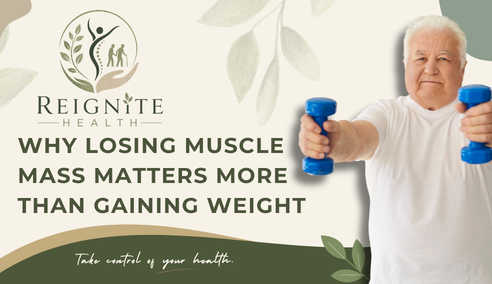
When people talk about changes in their body, the conversation often focuses on weight. The number on the scale goes up, and we worry about gaining weight. The number goes down, and we celebrate weight loss.
But there is another measurement that can tell us much more about physical health and independence: How much muscle are you maintaining?
As we age, lose weight, become less active, recover from illness or live with a chronic condition, we can lose muscle mass and strength. This can affect much more than appearance.
Muscle plays an important role in movement, balance, strength, metabolism and physical independence. That is why maintaining muscle should be an important part of your long-term health strategy.
Weight and Muscle Are Not the Same Thing
Your body weight is made up of many different components, including muscle, fat, bone, water, organs and other tissues. So when your weight changes, the number on the scale doesn’t tell you exactly what has changed.
For example, two people could weigh exactly the same but have very different amounts of muscle and body fat. This is particularly important when someone is trying to lose weight.
Losing weight isn’t necessarily the same as improving body composition. The goal should not simply be to make the number on the scale smaller. It should also be to maintain as much muscle and physical function as possible.
Why Does Muscle Matter?
Muscle does much more than make you look strong. Your muscles allow you to perform everyday activities such as:
- Walking
- Climbing stairs
- Getting out of a chair
- Carrying groceries
- Getting dressed
- Getting up from the floor
- Maintaining balance
- Exercising
- Playing with your children or grandchildren
When muscle strength declines significantly, everyday activities can become increasingly difficult. This can eventually affect independence and quality of life.
What Happens When You Lose Muscle?
Muscle loss can affect your physical capacity in several ways.
- Reduced Strength
- You may find everyday movements more difficult.
- Standing up from a chair or carrying something that was previously easy may require more effort.
- Reduced Balance
- Muscles play an important role in maintaining stability.
- Reduced Mobility
- Weakness can make walking, climbing stairs and other movements more demanding.
- Reduced Physical Capacity
- You may tire more quickly during activities that previously felt manageable.
- Loss of Independence
Why Muscle Loss can Happen with Weight Loss
If you lose weight, you don’t necessarily lose only body fat. Depending on factors such as your diet, activity levels, age and how quickly the weight is lost, some lean tissue can also be lost.
This is one reason why resistance exercise is an important component of many weight-management programmes. The goal isn’t simply:
“Lose as much weight as possible.”
A more useful question is:
“How can I improve my health and body composition while maintaining my strength and physical function?”
Muscle Loss can also Happen without Weight Loss
This is an important point. You don’t have to become lighter on the scale to lose muscle. Someone can maintain a relatively stable body weight while experiencing changes in body composition.
For example, muscle mass may decrease while fat mass increases. This is one reason why weight alone doesn’t provide a complete picture of physical health. Your strength and physical abilities can tell you a lot too.
Ageing and Muscle Loss
Muscle mass and strength naturally change as we age. However, ageing does not mean that becoming weak and inactive is inevitable. Regular physical activity, particularly resistance exercise, can help older adults maintain and improve muscle strength and physical function.
This is particularly important because maintaining muscle can help support the ability to:
- Walk independently
- Climb stairs
- Get out of a chair
- Carry objects
- Maintain balance
- Perform household activities
For older adults, strength training isn’t just about building muscle. It can be about protecting independence.
What About People with Chronic Conditions?
Muscle maintenance can also be particularly important for people living with chronic or neurological conditions. Reduced activity can occur because of pain, fatigue, reduced mobility, balance difficulties, illness, recovery from surgery, fear of movement, or reduced exercise tolerance.
When activity levels decrease for long periods, physical capacity can decline. This can create a cycle:
Less activity → reduced strength → activities become harder → even less activity
Exercise rehabilitation can help interrupt this cycle by gradually rebuilding physical capacity.
Muscle Strength is Different from Muscle Size
You don’t necessarily need to build large muscles to become stronger. Strength is influenced by several factors, including:
- Muscle size
- Nervous system function
- Coordination
- Exercise experience
- Movement technique
For many people, particularly older adults or those undergoing rehabilitation, the goal isn’t bodybuilding. It may simply be to become strong enough to perform everyday activities safely and independently.
How Can You Protect Your Muscle?
There are several important components to maintaining muscle and physical function.
1. Resistance Exercise
Resistance training is one of the most effective ways to challenge your muscles. This could involve weights, resistance bands, machines, bodyweight exercises, or functional resistance exercises.
The appropriate type and intensity depend on your current abilities and health.
2. Eat Enough Protein
Protein provides the building blocks needed for maintaining muscle tissue. Your individual protein requirements can vary depending on factors such as age, body size, activity levels and health status.
If you have a medical condition or specific dietary requirements, speak with an appropriately qualified healthcare professional or dietitian about your nutritional needs.
3. Stay Physically Active
Resistance training is important, but so is general movement. Walking, climbing stairs, gardening and other everyday activities all contribute to maintaining physical function.
The key is to avoid spending long periods completely inactive whenever possible.
4. Progress Gradually
Your muscles need an appropriate challenge.
If an exercise becomes easy, it may eventually need to be progressed.
This could mean gradually changing:
- Resistance
- Repetitions
- Sets
- Exercise difficulty
- Training frequency
Progress should be appropriate for your abilities and goals.
What If You’re Already Losing Muscle?
This process can be assessed and managed by a Biokineticist.
A Biokineticist can assess areas such as:
- Muscle strength
- Functional movement
- Balance
- Cardiovascular fitness
- Exercise tolerance
- Mobility
- Physical capacity
An exercise programme can then be developed around your current abilities. You may start with relatively simple exercises and gradually progress as your strength and confidence improve.
Muscle and Weight Management Shouldn’t Be Separated
Weight management is often treated as a numbers game.
But two people can lose the same amount of weight and have very different outcomes depending on what happens to their muscle, strength and physical function.
This is why a healthy approach to weight management should consider more than:
“How much do I weigh?”
Also ask:
- How strong am I?
- Can I get up from a chair easily?
- Can I climb stairs?
- Can I walk comfortably?
- Can I carry groceries?
- Am I maintaining muscle?
- Am I becoming more physically capable?
These are meaningful measures of health too.
How Can Biokinetics Help?
Biokinetics uses prescribed exercise to help improve physical function and exercise capacity. A Biokineticist can design an individualised programme that may include:
- Resistance training
- Cardiovascular exercise
- Functional strengthening
- Balance exercises
- Mobility exercises
- Exercise progression
The programme can be adapted according to your age, physical ability, health conditions and goals.
This can be particularly valuable for people who are:
- Losing weight
- Returning to exercise
- Older adults
- Recovering from illness or surgery
- Living with chronic conditions
- Experiencing reduced strength
- Becoming less physically active
Muscle Matters at Every Age
Building and maintaining physical capacity throughout adulthood can help create a stronger foundation for later life.
And if you’re already experiencing muscle loss, weakness or reduced mobility, it’s not too late to start working on your physical capacity.
Muscle Health and Healthy Ageing in Fourways
If you’re looking for a Biokineticist in Fourways to help you maintain strength, mobility and physical independence, Reignite Health provides individualised exercise programmes based on your needs.
Bokamoso Mthimkulu Biokineticist has a particular interest in helping people with chronic conditions, neurological conditions and older adults maintain physical function. The focus isn’t simply on how much you weigh.
It is on helping you stay strong, mobile and physically independent for as long as possible.
Final Thoughts
Weight is easy to measure. Physical capability is harder to put on a scale, but it matters just as much.
Losing muscle can affect your strength, balance, mobility, exercise tolerance and independence. Whether you’re losing weight, ageing, recovering from illness or simply becoming less active, maintaining muscle should be part of the conversation.
Don’t focus only on becoming lighter. Focus on becoming stronger, more capable and physically independent too.
Wishing you a lovely week ahead. Chat soon.
Bokz the Bio
Everybody has the ability to take control of their own health
Facebook: Reignite Health
LinkedIn: Reignite Health
Website: reignitehealth.co.za
WhatsApp: +27 83 562 9201
Email: bmbio@reignitehealth.co.za