
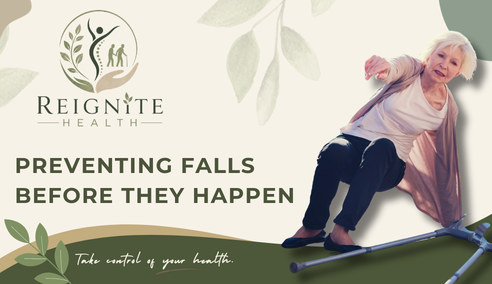
Falls are often thought of as something that simply happens as we get older. But many falls are influenced by changes in strength, balance, mobility, coordination and physical confidence that can be identified and addressed before a serious fall occurs.
The good news is that fall prevention is not only about being careful. Exercise-based intervention can play an important role in maintaining the physical abilities needed to move safely and confidently.
At Reignite Health in Fourways, Bokamoso Mthimkulu Biokineticist uses prescribed exercise and movement rehabilitation to help individuals improve their strength, balance, mobility and physical independence.
Why Do Falls Happen?
A fall can have many contributing factors. It is not always caused by one specific problem.
Some common physical factors include:
- Reduced leg strength
- Poor balance
- Decreased mobility
- Slower reactions
- Reduced coordination
- Difficulty getting up from a chair
- Changes in walking ability
- Reduced confidence when walking
- Muscle weakness after illness or hospitalisation
- Neurological conditions that affect movement or balance
- Joint pain or stiffness
- Reduced physical activity
Environmental factors can also contribute, such as loose rugs, poor lighting, clutter or slippery surfaces. This means that fall prevention needs to look at both the person and their environment.
5 Signs That Your Fall Risk May Be Increasing
You don’t necessarily need to have fallen already for fall prevention to become important.
1. You feel unsteady when walking
If you regularly feel unstable when walking, particularly when turning, changing direction or walking on uneven surfaces, it may be worth having your balance assessed.
2. You hold onto furniture or walls
Using furniture or walls for support can be a sign that your balance or lower-body strength needs attention.
3. Getting up from a chair is becoming difficult
Standing up from a chair requires strength from your legs and hips as well as coordination and balance.
Difficulty with this everyday movement may indicate declining functional strength.
4. You avoid certain activities because you are afraid of falling
Fear of falling can sometimes lead people to become less active.
Unfortunately, doing less physical activity can contribute to further losses in strength, mobility and confidence.
5. You have already had a fall or near-fall
A previous fall is an important reason to investigate what contributed to it.
Even if you weren’t injured, a fall or repeated near-falls may indicate that something has changed in your physical capacity.
How Can Biokinetics Help Prevent Falls?
Biokinetics uses individualised exercise as a therapeutic tool.
Rather than simply giving someone general exercises, a Biokineticist can assess areas such as strength, balance, mobility, walking ability and functional movement and then develop an exercise programme around the person’s needs.
1. Improving Leg Strength
Strong legs are important for everyday activities such as:
- Walking
- Climbing stairs
- Getting out of a chair
- Stepping over obstacles
- Getting up from the floor
- Maintaining stability when changing direction
A Biokineticist can prescribe progressive strengthening exercises appropriate for the person’s current ability. The goal isn’t necessarily to lift heavy weights. The goal is to develop the strength needed for everyday life.
2. Training Balance
Balance is a skill that can be trained.
Balance exercises can challenge different aspects of stability, including:
- Standing balance
- Weight shifting
- Changing direction
- Single-leg control
- Coordination
- Stability during movement
- Responding to changes in the environment
Exercises should be appropriately challenging and progressed gradually as the person’s abilities improve.
3. Improving Mobility
Being able to move your joints effectively can make everyday movement easier. A Biokineticist may work on mobility in areas such as the ankles, hips, knees, spine, and shoulders.
Mobility exercises may be incorporated alongside strengthening and balance work rather than used in isolation.
4. Practising Real-Life Movements
Fall prevention isn’t just about standing on one leg.
A good exercise programme should also consider the movements you need to perform during your day.
This may include practising:
- Sitting and standing
- Walking
- Turning
- Stepping
- Negotiating obstacles
- Getting up from the floor
- Using stairs
- Carrying objects safely
This is where exercise rehabilitation can become particularly valuable; the programme can be designed around function rather than just exercise.
Fall Prevention Is About Maintaining Independence
One of the biggest concerns associated with falls is not simply the injury itself.
After a fall, some people become afraid of falling again. This can result in avoiding activities and spending more time sitting or resting. Over time, reduced activity can contribute to further loss of strength and physical capacity.
Maintaining your physical abilities can therefore be an important part of maintaining independence and quality of life.
The aim of fall prevention is not to eliminate every possible risk. It is to help you maintain your physical capacity and confidence to move as safely and independently as possible.
You Don’t Have to Wait Until You Fall
Fall prevention should ideally begin before a serious fall occurs.
If you have noticed changes in your balance, strength, walking ability or confidence, an assessment can help identify areas that may benefit from exercise intervention.
This is particularly relevant for older adults and individuals living with conditions that can affect movement, balance or muscle strength.
A Biokineticist can assess your current abilities and develop a programme that starts at an appropriate level and progresses as your physical capacity improves.
When Should You See a Biokineticist?
Consider speaking to a Biokineticist if you:
- Have experienced a fall or repeated near-falls
- Feel increasingly unsteady
- Have difficulty with stairs
- Struggle to get up from a chair
- Have noticed reduced leg strength
- Avoid activities because of fear of falling
- Have reduced mobility
- Are becoming less physically active
- Are recovering from an illness, injury or hospitalisation
- Live with a neurological or chronic condition that affects movement
If you have experienced a sudden or unexplained change in balance, weakness, coordination or walking ability, seek appropriate medical assessment rather than assuming it is simply part of ageing.
Prevent Falls. Protect Your Independence.
Falls don’t always come out of nowhere. Changes in strength, balance, mobility and physical confidence can develop gradually. The earlier these changes are identified, the earlier appropriate exercise and rehabilitation can begin.
At Reignite Health in Fourways, Bokamoso Mthimkulu Biokineticist provides individualised exercise rehabilitation to help clients work on strength, balance, mobility and functional movement.
Wishing you a lovely week ahead. Chat soon.
Bokz the Bio
Everybody has the ability to take control of their own health
Facebook: Reignite Health
LinkedIn: Reignite Health
Website: reignitehealth.co.za
WhatsApp: +27 83 562 9201
Email: bmbio@reignitehealth.co.za