
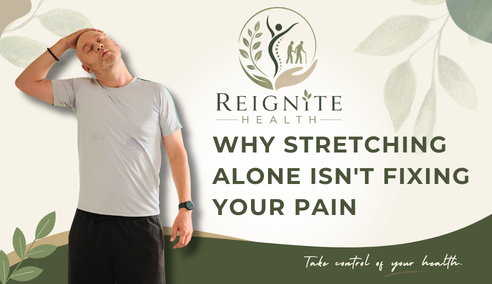
If you experience ongoing back, neck, hip, knee or shoulder pain, you may have tried stretching.
You stretch in the morning. You stretch after work. You follow videos online. You may even feel better immediately afterwards.
But then the pain comes back. So why isn’t stretching fixing the problem?
The answer is that stretching can be useful, but it is only one part of managing pain. Pain is often influenced by several factors, including muscle strength, mobility, physical capacity, movement habits, previous injuries and how your body responds to activity.
For many people, the solution isn’t simply to become more flexible. It is to develop a body that is strong, mobile and capable of handling everyday demands. This is where exercise rehabilitation and Biokinetics can play an important role.
Stretching Can Help, But It Isn’t a Complete Rehabilitation Programme
Stretching can be useful for improving flexibility and temporarily reducing feelings of stiffness or muscular tension.
However, if stretching is the only thing you’re doing, you may be missing other important components of rehabilitation.
For example, if you have recurring lower back pain, repeatedly stretching your hamstrings may feel good, but it doesn’t necessarily address:
- Reduced strength
- Poor muscular endurance
- Limited hip or spinal movement
- Reduced cardiovascular fitness
- Poor movement tolerance
- Deconditioning
- How you perform everyday activities
Your pain may therefore keep returning because the underlying physical problem hasn’t been fully addressed.
Pain Is More Complicated Than “A Tight Muscle”
One of the most common assumptions about pain is:
“It hurts because that muscle is tight.”
Sometimes muscle tightness is part of the picture. But pain is not always caused by a muscle simply being “too tight.” Pain can be influenced by many different factors, including:
- Previous injuries
- Joint problems
- Muscle weakness
- Reduced fitness
- Repetitive activities
- Prolonged inactivity
- Stress
- Sleep
- Movement sensitivity
- Changes in physical activity
- Other medical conditions
This is why treating pain requires looking at the whole person, rather than focusing on one tight muscle.
Why Does Stretching Sometimes Feel So Good?
Stretching and gentle movement can sometimes temporarily reduce the sensation of stiffness or discomfort. It can also help you feel more comfortable moving through a particular range of motion. That immediate improvement can be useful.
The problem is expecting that temporary relief to permanently resolve the reason your pain keeps returning. Think of stretching as one tool in your toolbox, rather than the entire toolbox.
You May Need Strength, Not Just Flexibility
One of the biggest things that can be missing from a stretching-only approach is strength training. Your muscles don’t only need to be flexible. They need to be strong enough to handle the activities you ask them to perform.
For example, if you experience knee pain when climbing stairs, repeatedly stretching your legs may not address the strength and control required to climb those stairs comfortably. A rehabilitation programme may instead include progressive strengthening of the quadriceps, hamstrings, glutes, calves, core and trunk muscles. The exercises would then be progressed according to your abilities and goals.
Your Body Needs to Be Able to Tolerate Activity
Another important concept is exercise capacity. If your body isn’t accustomed to a particular activity, doing too much of it can sometimes result in increased discomfort.
For example, someone who rarely walks may experience pain when suddenly starting long walks every day. The solution isn’t necessarily to stop moving. Instead, you may need to gradually build your body’s capacity to tolerate the activity.
This is one of the key principles of exercise rehabilitation.
Mobility and Flexibility Are Not Exactly the Same
These terms are often used interchangeably, but they aren’t identical.
Flexibility generally refers to the ability of muscles and other tissues to lengthen. Mobility is your ability to actively move a joint or body segment through its available range of motion. You may have good flexibility but still struggle with movement control or strength.
For example, someone may be able to passively move their leg through a large range but struggle to control that movement during walking, squatting or climbing stairs.
What About Foam Rolling?
Foam rolling and other forms of self-massage can also provide temporary relief for some people. They may help you feel less stiff or more comfortable moving. But just like stretching, foam rolling is not necessarily a complete solution for persistent pain.
If you constantly need to roll or stretch the same area to feel comfortable, it may be worth asking: Why does the discomfort keep coming back?
That is where an assessment can be useful.
Exercise Can Help Build a More Resilient Body
Instead of constantly trying to remove every sensation of tightness, rehabilitation can focus on improving your body’s capacity.
Depending on your needs, this may involve strength, building the muscles needed for everyday activities, endurance, improving your ability to perform activities without becoming excessively fatigued, mobility, improving your ability to move comfortably, balance, improving stability and confidence during movement, coordination, helping your body perform movements more efficiently, functional movement, or practicing movements that relate to your everyday life.
Why Progressive Exercise Matters
Your body adapts to the demands you place on it. This is why rehabilitation usually involves gradual progression.
As you become stronger or more comfortable with an exercise, your Biokineticist may adjust:
- Resistance
- Repetitions
- Sets
- Exercise duration
- Range of motion
- Exercise complexity
- Rest periods
The goal is not to make every session harder for the sake of being harder. The goal is to provide an appropriate challenge that helps your body adapt.
What If Exercise Makes My Pain Worse?
Exercise isn’t automatically appropriate simply because it is exercise. The type, intensity and volume of exercise matter. If a particular exercise consistently causes significant pain or leaves you feeling worse, it may need to be modified.
A Biokineticist can help determine whether you need to change:
- The exercise itself
- The intensity
- The number of repetitions
- Your range of movement
- Your recovery time
- How quickly you progress
The goal is to find an appropriate level of challenge.
When Should You See a Biokineticist for Pain?
Consider an assessment if your pain:
- Keeps coming back
- Has been present for a long time
- Limits your everyday activities
- Makes exercise difficult
- Causes you to avoid movement
- Is affecting your strength or mobility
- Has resulted in reduced physical activity
- Has not improved despite your usual stretching routine
A Biokineticist can assess your physical function and determine whether an individualised exercise programme may be appropriate. If your pain is new, severe, unexplained or associated with concerning symptoms, you should first seek appropriate medical assessment.
Exercise Rehabilitation for Pain in Fourways
If you’re searching for pain rehabilitation in Fourways, exercise therapy may offer a more comprehensive approach than stretching alone. At Reignite Health, Bokamoso Mthimkulu Biokineticist provides individualised Biokinetics programmes designed around your physical abilities, condition and goals. The focus is not simply on making you stretch more. It is about helping you develop the strength, mobility, endurance and confidence to move more effectively.
Final Thoughts
Stretching can be helpful. But if you’ve been stretching the same painful area for months and the pain keeps returning, it may be time to look beyond flexibility. Your body may need strength, movement, endurance, progressive exercise as well.
Instead of asking:
“What can I stretch to make this pain go away?”
It may be more useful to ask:
“What does my body need to become stronger and more capable?”
That’s where a personalised exercise rehabilitation programme can make a difference.
Wishing you a lovely week ahead. Chat soon.
Bokz the Bio
Everybody has the ability to take control of their own health
Facebook: Reignite Health
LinkedIn: Reignite Health
Website: reignitehealth.co.za
WhatsApp: +27 83 562 9201
Email: bmbio@reignitehealth.co.za