
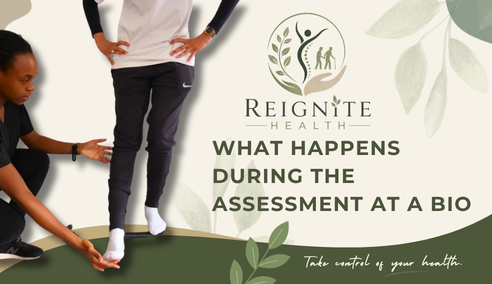
If you’ve never seen a Biokineticist before, you may be wondering:
“What actually happens during a Biokinetics assessment?”
Perhaps you’ve been referred by your doctor or Physiotherapist, you’re experiencing chronic pain, or you’ve simply decided it’s time to improve your strength and fitness. Whatever your reason, knowing what to expect can make your first appointment feel much more comfortable.
A Biokinetics assessment is much more than simply being asked to exercise. It is a comprehensive evaluation of how your body moves, functions, and responds to physical activity.
At Reignite Health, Bokamoso Mthimkulu Biokineticist uses the assessment to understand your individual needs and develop a personalised exercise rehabilitation programme.
What Is a Biokinetics Assessment?
A Biokinetics assessment is a structured evaluation of your physical health, movement, strength, mobility, balance, and functional ability.
The purpose is to understand:
- How your body currently functions
- What may be contributing to your symptoms
- Where weaknesses or limitations exist
- What your exercise capacity is
- What your goals are
- Which exercises are appropriate for you
The assessment allows your Biokineticist to create an exercise programme that is specific to you, rather than giving you a generic exercise routine.
Step 1: We Start with a Conversation
Before any physical testing begins, your Biokineticist will want to understand you.
This is an important part of the assessment.
You may be asked about:
- Your medical history
- Your family’s medical history
- Previous injuries
- Current symptoms
- Medications
- Previous surgeries
- Current physical activity
- Work and lifestyle
- Exercise history
- Your goals
- Activities you struggle with
For someone experiencing chronic pain, for example, we want to understand not only where you hurt, but also how the pain affects your daily life.
For someone recovering from a neurological condition, the assessment may focus more heavily on mobility, balance, coordination, endurance, and functional independence.
Step 2: We Discuss Your Goals
Your assessment isn’t just about identifying what’s wrong.
It’s also about understanding what you want to achieve.
Your goal might be to:
- Walk without pain
- Climb stairs more easily
- Return to running
- Improve your fitness
- Manage your weight
- Build strength
- Improve your balance
- Recover after surgery
- Manage arthritis
- Manage a neurological condition
- Prevent falls
- Return to work
- Stay independent as you age
Your goals help guide your rehabilitation programme.
Step 3: Postural Assessment
Depending on your condition, your Biokineticist may assess your posture.
This may involve looking at:
- Head and neck position
- Shoulder alignment
- Spinal position
- Pelvic alignment
- Hip position
- Knee alignment
- Foot position
Posture isn’t about looking “perfect.” Instead, we’re interested in understanding how your body is positioned and how this may influence your movement.
This can be particularly useful for people experiencing:
- Neck pain
- Shoulder pain
- Lower back pain
- Hip pain
- Recurring injuries
Step 4: Mobility and Flexibility Testing
Your Biokineticist may assess how freely your joints can move.
This can include assessing:
- Neck mobility
- Shoulder movement
- Hip mobility
- Knee movement
- Ankle mobility
- Spinal movement
Reduced mobility can affect how you perform everyday activities and may contribute to compensatory movement patterns.
Step 5: Strength Testing
Strength testing helps identify areas of weakness and muscle imbalance.
Depending on your needs, we may assess:
- Upper-body strength
- Lower-body strength
- Core strength
- Grip strength
- Functional strength
Strength testing is particularly important for people dealing with:
- Chronic pain
- Arthritis
- Neurological conditions
- Joint replacements
- Sports injuries
- Age-related muscle loss
Step 6: Balance Assessment
Balance is an important part of physical function, particularly as we get older.
Your Biokineticist may assess:
- Static balance
- Dynamic balance
- Single-leg balance
- Weight shifting
- Coordination
Balance testing can help identify whether you’re at increased risk of falling and whether specific balance exercises should form part of your programme.
Step 7: Cardiovascular Fitness
Depending on your health and goals, your Biokineticist may assess your cardiovascular fitness.
This can help determine:
- Your exercise tolerance
- Heart and lung fitness
- Endurance
- Appropriate exercise intensity
- How your body responds to physical activity
For individuals with chronic conditions, this information is particularly valuable when designing a safe exercise programme, but may not always be necessary to start.
Step 8: Functional Movement Assessment
This is where we look at how your body performs real-life movements.
You may be asked to perform movements such as:
- Sitting and standing from a chair
- Squatting
- Stepping
- Walking
- Reaching
- Balancing
- Lifting
The purpose isn’t to see whether you can perform a movement “perfectly.”
It’s to understand how you move.
This can reveal compensations, weaknesses, or mobility limitations that may not be obvious during a standard strength test.
Step 9: We Put the Information Together
Once your assessment is complete, your Biokineticist reviews the findings and identifies your key areas of focus.
For example, you may have:
Knee pain → weak quadriceps + reduced hip strength + poor balance
or:
Neck pain → reduced upper-back strength + limited thoracic mobility + prolonged sitting
or:
Age-related weakness → reduced lower-body strength + poor balance + reduced cardiovascular fitness
This allows us to develop a programme based on your individual needs.
Step 10: Your Personalised Programme Is Developed
The final stage is creating your exercise rehabilitation programme.
Your programme may include strength training, mobility exercises, cardiovascular exercise, balance training, core exercises, functional exercises. The programme is progressed as your body adapts.
Does a Biokinetics Assessment Hurt?
It shouldn’t as your Biokineticist will work within your current abilities and medical limitations.
Some exercises may feel challenging, particularly if you’re deconditioned or recovering from an injury, but the assessment should not be about pushing you beyond your limits.
If you’re experiencing pain or discomfort during a test, communicate this to your Biokineticist so the assessment can be modified appropriately.
What Should You Wear?
Wear comfortable clothing that allows you to move freely.
For example, comfortable shorts or leggings, t-shirt or sports top, comfortable athletic shoes. Your Biokineticist needs to be able to observe your movement and posture, so restrictive clothing isn’t ideal.
How Long Does a Biokinetics Assessment Take?
The length of an assessment depends on your condition, goals, and each Biokinetics practice.
A comprehensive assessment may take approximately 45-60 minutes, particularly when dealing with chronic conditions, neurological conditions, post-operative rehabilitation, or multiple areas of concern.
Who Can Benefit from a Biokinetics Assessment?
Biokinetics can benefit people of all ages and fitness levels, including individuals experiencing:
- Chronic pain
- Lower back pain
- Neck pain
- Knee pain
- Hip pain
- Shoulder pain
- Arthritis
- Osteoporosis
- Multiple Sclerosis
- Parkinson’s disease
- Stroke recovery
- Diabetes
- Neuropathy
- Balance difficulties
- Age-related muscle loss
- Post-surgical rehabilitation
- Healthy individuals looking to get active and prevent future problems
Why Is an Assessment Important?
One of the biggest mistakes people make when starting an exercise programme is choosing exercises based on what they think they need.
For example, someone with knee pain may immediately start strengthening their quadriceps without considering:
- Hip strength
- Ankle mobility
- Balance
- Walking mechanics
- Training load
- Previous injuries
A Biokinetics assessment allows your programme to be based on objective findings rather than guesswork.
Why Choose a Biokineticist in Fourways?
If you’re searching for a Biokineticist in Fourways, Reignite Health provides personalised exercise rehabilitation for individuals wanting to improve their movement, manage chronic conditions, recover from injury, and maintain their independence.
Bokamoso Mthimkulu Biokineticist takes the time to understand the person behind the symptoms. Your assessment isn’t simply about numbers or test results.
What Happens After Your Assessment?
Your assessment is only the beginning. Once your programme has been developed, your Biokineticist will guide you through the exercises and progressively adapt the programme as your body becomes stronger and more capable.
Progress may be measured through:
- Improved strength
- Better balance
- Increased mobility
- Reduced pain
- Improved endurance
- Better functional ability
- Greater confidence
- Improved quality of life
The goal is progress, not perfection.
Final Thoughts
A Biokinetics assessment provides an opportunity to understand your body better. Whether you’re dealing with chronic pain, recovering from an injury, managing a neurological condition, preparing for surgery, or simply wanting to improve your health, an assessment provides the foundation for a safe and personalised exercise programme. You don’t need to be fit or injured before seeing a Biokineticist.Top of Form
Bottom of Form
Wishing you a lovely week ahead. Chat soon.
Bokz the Bio
Everybody has the ability to take control of their own health
Facebook: Reignite Health
LinkedIn: Reignite Health
Website: reignitehealth.co.za
WhatsApp: +27 83 562 9201
Email: bmbio@reignitehealth.co.za