
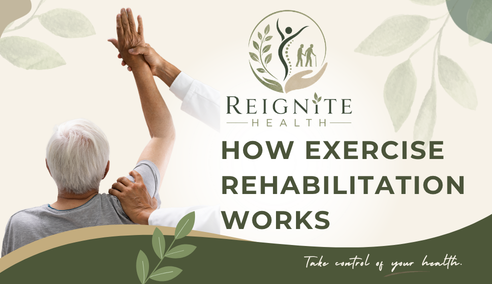
When you hear the words exercise rehabilitation, you may picture someone doing a few stretches or exercises after an injury. But exercise rehabilitation is much more than that.
It is a structured, individualised approach to using exercise to restore, maintain or improve physical function. It can be used after an injury or surgery, but it can also help people living with chronic pain, neurological conditions, chronic diseases, or age-related changes in physical function.
At Reignite Health, Bokamoso Mthimkulu Biokineticist uses personalised exercise therapy to help clients improve their strength, mobility, balance, endurance and independence.
What Is Exercise Rehabilitation?
Exercise rehabilitation is the use of specifically prescribed and monitored exercise to help improve physical function. The programme is designed around the individual rather than simply the diagnosis.
For example, two people may both have knee pain but have completely different strength levels, mobility, fitness, pain levels, movement patterns, medical histories, or functional goals.
Their rehabilitation programmes should therefore not necessarily be the same. A Biokineticist assesses where you are starting from and develops an exercise programme that is appropriate for your current abilities.
Who Can Benefit from Exercise Rehabilitation?
Exercise rehabilitation isn’t only for athletes or people recovering from major injuries. It can benefit people experiencing a wide range of physical challenges, including:
- Chronic lower back pain
- Neck pain
- Knee, hip and shoulder pain
- Arthritis
- Joint replacements
- Sports injuries
- Post-surgical rehabilitation
- Neurological conditions such as Multiple Sclerosis and Parkinson’s disease
- Stroke
- Diabetes
- Neuropathy
- Balance problems
- Reduced mobility
- Age-related physical decline
It can also be used by people who simply want to improve their physical health and maintain their independence.
How Does Exercise Rehabilitation Work?
A successful rehabilitation programme usually follows a process.
Assessment → Plan → Exercise sessions and home program → Reassess → Progress/adjust.
This process allows your Biokineticist to understand your needs and adjust your programme as your body changes.
Let’s look at each stage.
Step 1: Your Initial Assessment
The first step is understanding you. Your Biokineticist will discuss your medical history, current symptoms, lifestyle, activity levels and goals. Depending on your needs, your physical assessment may include:
- Muscle strength
- Joint mobility
- Balance
- Cardiovascular fitness
- Flexibility
- Functional movement
- Endurance
- Postural control
- Exercise tolerance
The assessment gives your Biokineticist a clearer picture of your current physical function. It also helps identify where rehabilitation should begin.
Step 2: Setting Your Goals
Rehabilitation should have a purpose. Your goal may be something simple and practical, such as:
“I want to walk further without getting tired.”
Or:
“I want to get up from a chair more easily.”
Perhaps you want to:
- Return to exercise
- Climb stairs
- Walk your dogs
- Return to work
- Improve your balance
- Reduce your dependence on others
- Prepare for surgery
- Recover after surgery
- Improve your strength
Your Biokineticist can use these goals to help guide your programme.
Step 3: Creating Your Exercise Programme
Once your Biokineticist understands your needs, an exercise programme can be developed. Depending on your goals, this may include:
- Strength Training
- To improve muscle strength and physical capacity.
- Cardiovascular Exercise
- To improve endurance and cardiovascular fitness.
- Mobility Exercises
- To improve comfortable movement around the joints and body.
- Balance Training
- To improve stability and confidence during movement.
- Functional Exercise
- To practice movements that relate directly to everyday activities.
- Flexibility Exercises
Where appropriate, exercises can be included to address flexibility and movement limitations.
Step 4: Starting at the Right Level
One of the most important principles of rehabilitation is starting at an appropriate level. You don’t need to push yourself as hard as possible. In fact, doing too much too soon can make rehabilitation unnecessarily difficult. Your programme may initially involve simple exercises with low resistance or short periods of cardiovascular activity. As your body adapts, the programme can gradually become more challenging. This is known as progressive overload.
Step 5: Gradually Increasing the Challenge
Your body adapts to exercise. If you always perform exactly the same exercise at exactly the same intensity, your progress may eventually plateau. Your Biokineticist can gradually adjust factors such as resistance, repetitions, sets, exercise duration, exercise complexity, balance challenge, and cardiovascular intensity. Progression should be appropriate for your condition and goals.
Step 6: Learning How Your Body Responds
Rehabilitation isn’t simply about completing your exercises. It’s also about understanding how your body responds. Your Biokineticist may monitor:
- Pain
- Fatigue
- Heart rate
- Exercise tolerance
- Muscle response
- Balance
- Recovery
- Functional performance
This is particularly important for people living with chronic or neurological conditions where symptoms and exercise tolerance can vary.
Step 7: Functional Rehabilitation
Exercise rehabilitation should eventually translate into real-life movement. For example, if your goal is to improve your ability to climb stairs, your programme may include exercises that develop:
- Leg strength
- Balance
- Coordination
- Cardiovascular fitness
If your goal is to improve your ability to get out of a chair, your programme may include progressive exercises that target the muscles and movement patterns involved in standing. The aim is to bridge the gap between exercise and everyday life.
Step 8: Reassessment
Rehabilitation isn’t a one-time process. Your Biokineticist can reassess your physical abilities periodically to determine whether you are progressing. This can help answer questions such as:
- Has your strength improved?
- Is your balance better?
- Can you walk further?
- Has your endurance improved?
- Are everyday activities easier?
- Can your exercises be progressed?
- Does your programme need to change?
Your programme should evolve as you do.
How Long Does Exercise Rehabilitation Take?
The length of the rehabilitation programme depends on:
- Your condition
- Your starting physical ability
- Your goals
- Your consistency
- Your response to exercise
- The complexity of your rehabilitation needs
Some people may need a short programme following an injury. Others may benefit from long-term exercise therapy to manage a chronic or neurological condition. For some individuals, rehabilitation eventually transitions into a long-term exercise and health programme.
But most rehabilitation programmes are for a minimum of 6 weeks with one session a week.
Is Exercise Rehabilitation Painful?
Exercise rehabilitation should not simply mean pushing through pain. Some exercises may feel challenging, and muscle fatigue can be normal. However, significant or worsening pain should not be ignored.
Your Biokineticist can modify exercises by changing:
- The movement
- Resistance
- Range of motion
- Repetitions
- Exercise duration
- Rest periods
The goal is to challenge your body appropriately while keeping the programme safe and manageable.
Exercise Rehabilitation for Chronic Conditions
One of the important roles of Biokinetics is helping people remain physically active while living with chronic conditions.
For example, someone with Multiple Sclerosis may need a programme that considers fatigue, strength, balance and exercise tolerance. Someone with arthritis may need to work on joint mobility, strength and functional movement. Someone with Parkinson’s disease may benefit from exercises targeting balance, mobility, strength and endurance. Someone living with chronic pain may need a gradual approach to rebuilding movement and physical capacity. The programme is adapted to the individual.
Exercise Rehabilitation for Older Adults
Ageing doesn’t mean that becoming weaker and less mobile is unavoidable. Some physical decline occurs naturally with age, but regular physical activity and appropriate strength training can help older adults maintain physical function and independence.
Exercise rehabilitation for older adults may focus on strength, balance, mobility, walking ability, cardiovascular fitness, fall prevention, and functional independence The goal is to remain capable of doing the things you want to do.
Why Choose a Biokineticist for Exercise Rehabilitation?
A generic exercise programme doesn’t take into account the individual sitting in front of you. A Biokineticist can assess your physical abilities and develop an exercise programme based on your specific needs.
This is particularly valuable when you’re dealing with:
- Chronic conditions
- Persistent pain
- Neurological conditions
- Previous injuries
- Surgery
- Reduced mobility
- Balance problems
- Age-related physical changes
Exercise Rehabilitation in Fourways
If you’re looking for exercise rehabilitation in Fourways, Reignite Health provides personalised Biokinetics programmes designed around your physical health and functional goals.
Bokamoso Mthimkulu Biokineticist has a particular interest in chronic conditions, chronic pain, neurological rehabilitation and elderly health and wellness. The focus is not simply on completing exercises, it is about helping you move better, become stronger and maintain as much physical independence as possible.
Final Thoughts
Exercise rehabilitation is a process. It starts with understanding where you are now, identifying where you want to be, and developing a structured plan to help you get there. The process may involve:
Assessment → Individualised programme → Exercise → Reassessment → Progression
Whether you’re recovering from surgery, managing chronic pain, living with a neurological condition, experiencing reduced mobility, or simply wanting to improve your physical function, exercise rehabilitation can be an important part of your healthcare journey.
Movement is something you can work on at every stage of life.
Wishing you a lovely week ahead. Chat soon.
Bokz the Bio
Everybody has the ability to take control of their own health
Facebook: Reignite Health
LinkedIn: Reignite Health
Website: reignitehealth.co.za
WhatsApp: +27 83 562 9201
Email: bmbio@reignitehealth.co.za